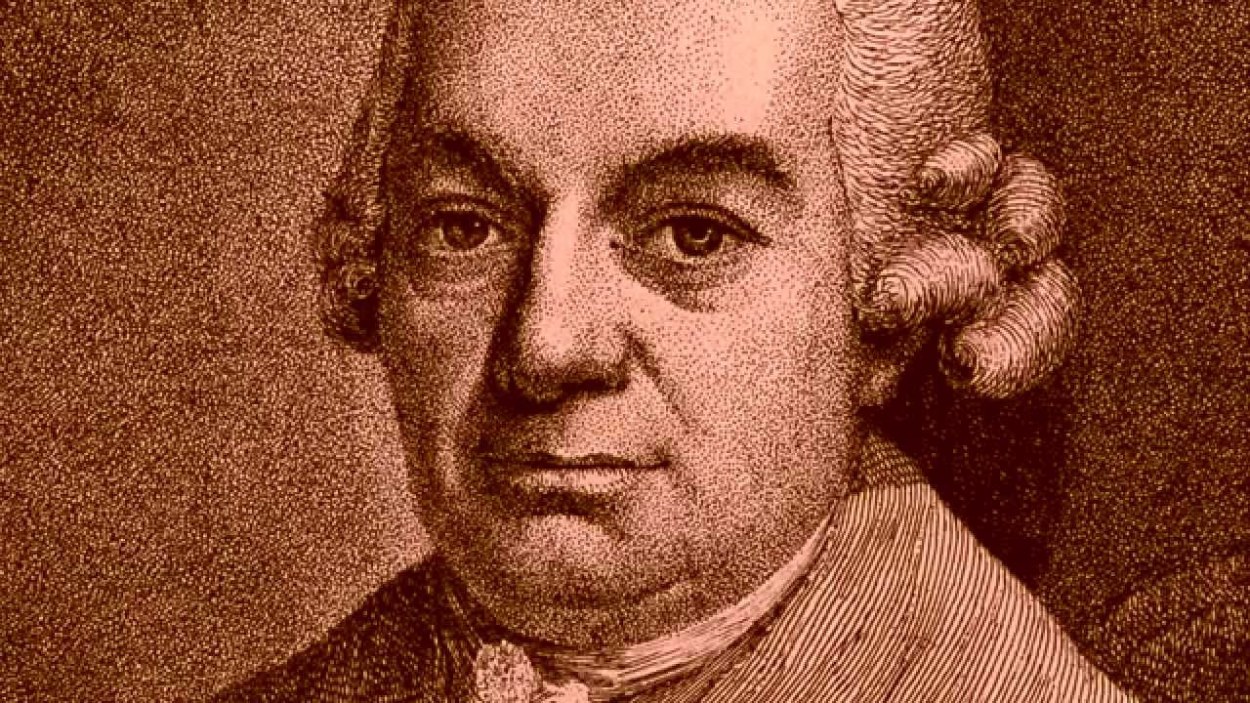
We recently saw the 308th birthday of Carl Philipp Emanuel Bach (1714-1788), my personal favorite composer. So I want to take the opportunity to remember his life, and discuss his works. I’ll leave a short biography below, as well as share and discuss online resources and, of course, his music.
Biographical Outline:
Emanuel’s compositional career can easily be split into two periods. 30 years in Berlin, and 20 years in Hamburg. I will start from the beginning, however.
1714-1738
- Born in Weimar on March 8th, 1714, to J.S. Bach and his first wife, Maria Barbara.
- His godfather was Georg Philipp Telemann. This is where he got his middle name, and this fact will also be relevant later on in his life.
- Trained by his father in music, and studied music at the St. Thomas School in Leipzig from age ten
- Graduated from the University of Leipzig in 1738 with a law degree at age 24, but never practiced law.
1738-1768, The Berlin Years
- Moved to Berlin in the service of the future Frederick the Great (who would acsend to the throne in 1740) as court keyboardist
- Frederick enjoyed playing the flute, and beyond simply accompnanying the king, Emanuel composed many flute concerti for the king to perform during his time in Berlin.
- Wrote a great deal of keyboard sonatas during this time, including the Prussian Sonatas (1742), Württemberg Sonatas (1744), Probestücke Sonatas (1753, Reprisen Sonatas (1760), Fortsetzung Sonatas (1761), Leichte Sonatas (1766), and many more not part of any particular set.
- His wonderful Magnificat was written in this period
- Wrote his famous “Essay on the True Art of Playing Keyboard Instruments” during this time (1753), which would continue to be referenced by musicians for nearly a century, and is still a very important historical reference.
1768-1788, The Hamburg Years
- After Telemann’s death in 1767, the city of Hamburg needed someone to succeed his role as Kantor of the Johanneum (a local school) and as kapellmeister to the largest local churches; his godson, Emanuel Bach, was chosen, and brought in. Bach was happy to accept the new position in 1768, as his position in Frederick’s court was not without conflict
- Due to his religious new duties, as well as the patronage of Frederick’s sister, Princess Anna Amalia (who loved vocal works), Bach wrote a massive amount of choral works during this time. These include several oratios, twenty one settings for the Passion, over seventy cantatas, and dozens of motets and litanies. Notably, the stunning masterpiece that is his Die Israeliten in der Wüste (1768)
- He died on December 14th, 1788, at 74 years of age
Resources:
- https://www.cpebach.org is an incredible resource. The site not only contains probably the biggest collection of C.P.E. Bach scores (even rivaling imslp), but the scores are extremely high quality; they aren’t scans of documents, but actually digitally created scores, so they are very clear.
- Ana-Marija Markovina has recorded EVERY single keyboard sonata, fantasia, rondo, etc. that C.P.E. Bach wrote, and she has done so with great recording equipment and artistic playing. As long as you know the Wq. number for a keyboard work, you can find it on YouTube by searching the title along with her name.
Personal Favorites:
Keyboard Works
- Wq. 51, No. 2 Mvt.1 (1761) I love how he uses that sequence that shows up in the first half in the development.
- Wq. 52, No. 4 Mvt.1 (1763) Fiery turbulence interlaced with song-like lyricism make for a great opening movement
- Wq. 62, No. 16 Mvt.1 and Mvt.2 (1757) The first movement has a great groove to it, and features some nice delayed cadences. The second movement is very lyrical and intimate.
- Wq. 65, No. 14 Mvt.2 (1744) This one is stunning. Absolutely captivating.
- Wq. 65, No. 24 (1749) This is really something: thick textures, overwhelmingly in two tempi (adagio and andante), and fantasia-like in its construction.
- Wq. 65, No. 31 Mvt.1 and Mvt.3 (1757) The allegro is strange, but it has a ton of character. The scherzando is a blast: very fiery; it would be a good encore piece.
- Wq. 65, No. 33 Mvt.1, Mvt. 2, and Mvt.3 I love how the modulation in the first movement’s exposition is handled. The second movement is really a masterpiece in its own right. The minuet is a great finale: jaunty, with lots of forward momentum
- Wq. 63, No. 6 Mvt.1 (1753) This is one of the six “Probestucke Sonatas”, which were included in his great treatise. The hand crossing seems an anticipation of later Beethoven works. Beethoven, in fact, studied the treatise, and these pieces, as a boy.
- I talk about more keyboard sonatas in greater depth here.
Orchestral
- Symphony in D Major Wq.183/1 Such a memorable opening.
- Symphony in E Minor Wq.178 What an incredible symphony on its own terms, not even mentioning the fact that it was composed in 1756. (Just listen to how the andante is showcasing musical phrasing that would still be in vogue for the next 50 years; you can hear echos of this sound from Haydn to Mozart).
- Keyboard Concerto in D Minor Wq.23 While I usually prefer historical instruments, I’m not purist, and this is a great rendition on a modern piano.
- Cello Concerto in A Minor wq.170 This piece is more well known, I believe, and for good reason. It really captures a lot of Emanuel’s voice. (You may have heard this arranged for other solo instruments, but I believe the cello version is the original)
Chamber Works
- Bußlied Songs don’t typically come to mind when one thinks of CPE Bach, but this is a beautiful example of what he could do in this genre. It’s haunting.
- Trio Sonata for Two Flutes The second movement in particular is great.
Sacred
- Die Auferstehung This work is a monumental achievement, and a masterpiece. This is the piece that Emanuel Bach wished to be remembered by. The uploader is well known for his controversial tempo research, but that’s totally irrelevant to the enlightening information he has to share about this piece in the first six minutes of the video.
Quotes:
“A musician cannot move others unless he too is moved. He must of necessity feel all of the affects that he hopes to arouse in his audience, for the revealing of his own humour will stimulate a like humour in the listener.”
C.P.E. BACH
“Keyboardists whose chief asset is mere technique… more often than not astound us with their prowess without ever touching our sensibilities. They overwhelm our hearing without satisfying it and stun the mind without moving it.”
C.P.E. BACH
“The clavichord is the instrument on which one can most accurately judge a keyboard player.”
c.p.e. bACH
“He is the father, we are the children. Those of us who know anything at all learned it from him.”
-Mozart, when asked of his opinion of Emanuel Bach’s playing in a visit by Mozart to Hamburg.
“Be sure of procuring Emanuel Bach’s treatise.”
BEETHOVEN, TO HIS STUDENT: CARL CZERNY
Afterthoughts
C.P.E. Bach was a giant of his time. From the 1740s, and well into the 1800s, if the name “Bach” was mentioned, it would be almost certain the reference was to “C.P.E. Bach”. Not only a notable keyboardist, but a genius composer as well. Not to mention his massive impact on keyboard technique and education (It’s incredible that his treatise was still being used to teach by Beethoven, among others, over 50 years after its publication.) It would be difficult to overstate his influence on the German musical world, and it was a great shame how long his name lived in obscurity as an inconsequential “transitional composer”. Thankfully, his reputation has received a much deserved resurrection in recent decades, and I hope it continues to swell.
If you have any favorite pieces by him, or any anecdotes, comments, or questions, I encourage you to comment below. Otherwise, I’m just happy to share a small part of this great composer~
 Exploring Music
3 thoughts on “Celebrating C.P.E. Bach~”