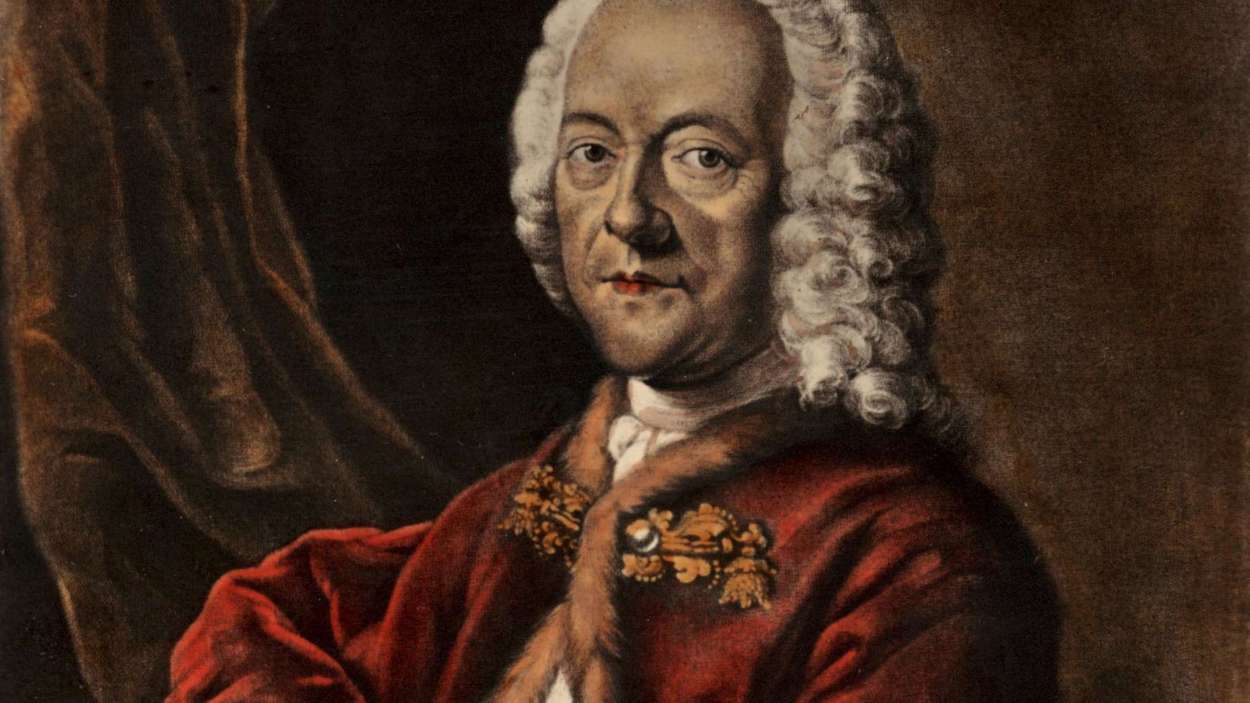
Today marks the 341st birthday of Georg Philipp Telemann, by many accounts the most prolific composer in history, writing more than 3,000 pieces.
Today is a good opportunity to remember his life and discuss his works, so I hope you all will join me below.
Biographical Outline:
Telemann’s compositional career can roughly be split into two periods: 40 years with frequent movement, and 46 years spent in Hamburg.
1681-1721 The pre-Hamburg Years:
- Born in Magdeburg, Brandenburg-Prussia on March 24, 1681
- After a childhood of secret music study (against his families wishes), he studied 4 years at the Hildesheim Gymnasium (1697-1701), and another 4 years at the Leipzig University (1701-1705). He became proficient in composing for and the teaching of all the common instruments, as well as becoming a skilled performer himself.
- From his 1705 graduation to 1712 (minus a brief excursion to Sorau, Poland), Telemann served under Duke Johann Wilhelm as Konzertmeister and Kapellmeister in Eisenach (this town may be familiar to some as J.S. Bach’s birth-town).
- Moved to Frankfurt to serve as Kapellmeister at St. Catherines’s Church (1712-1721) shortly after the death of his first wife (of only 2 years) during childbirth (1711)
- Married his second wife, Maria Textor, in 1714 (with which he had 9 children)
- Already by this point Telemann had authored a great many pieces: operas; dozens of cantatas; dozens of sonatas and concertos; dozens of suites and chamber pieces; his grand Brockes-Passion.
1721-1767 The Hamburg Years:
- Telemann moved to Hamburg to accept the position of Kantor at the Johanneum Lateinschule in 1721; save for a few trips around Germany (and notably an 8-month stay in Paris in 1737) this is where he would stay for the rest of his life.
- His second wife racked up absurd amounts of gambling debts (more than Telemann’s annual income) and was unfaithful. They no longer lived together by the 1730s, and she eventually left him for a Swedish officer.
- While his composition slowed down in the 1740s, he continued to compose into the 1760s.
- He died on June 25, 1767, after which his godson, C.P.E. Bach took over his Kantor position.
Notes on the Composer:
- As mentioned in the introduction, Telemann is widely regarded as the most prolific composer in history (a combination of his industriousness as well as his long life of 86 years).
- He was a personal friend to both J.S. Bach and G.F. Handel, which explains C.P.E. Bach being his godson (the “P.” in “C.P.E.” is for Philipp).
- To his contemporaries, and at least until the complete takeover of the galant style, Telemann was oft regarded as the greatest living composer, and was popular throughout europe.
- Telemann was one of the earliest composers to focus on self-publishing, paving the way for later composer-publishers (notably C.P.E. Bach and Muzio Clementi).
- Telemann was also an accomplished writer. He wrote no less than three autobiographies (here is the last one, written in 1740), much poetry (more info here), and a great deal of writings on music theory and performance practice.
- His compositions after 1738, especially vocal compositions, have a notable French influence due to his enamoration with Rameau’s opera “Castor et Pollux”, which he saw performed in Paris.
- He was quite interested in hobby-gardening (especially later in life); from a letter of his: “I am insatiable where hyacinths and tulips are concerned, greedy for ranunculi, and especially for anemones”.
Compositional Output:
For any genre, national style, or instrument one could think of in the mid-18th century, it can be certain that Telemann has a relevant composition. Passions, suites, concertos and sonatas for every instrument, cantatas by the hundreds, operas, oratorios, French/German/English/Italian styles, works for keyboard, works for specifically organ, etc etc etc…
Attempting to break them all down here would be fruitless; one might as well simply read an encyclopedic overview. As such, I will link this. At the bottom of his Wikipedia page is a “Partial List of Works”, with links galore for anyone looking for a rabbit hole to go down.
Personal Favorites/Notable Works:
This list is not necessarily his “most important works”, just ones I enjoy the most, as well as ones that stand out for their novelty or ingenuity.
- Overture-Suite in E Minor, TWV 55:e1 This is just pure baroque craftmanship right here.
- TWV 55:F11, “Alster”: VII. Die Konzertierenden Frosche und Krahen This translates to “concertizing frogs and crows”, roughly. It is very easy to see why he titled it such. Quite an interesting piece for the 18th century (even today).
- Violin Concerto in A Major “Die Relinge” TWV 51:A4 This title translates to “The Toad”, in reference to the effects at this section; such beautiful sounds, inspired from such a course animal. Perhaps a bit more toad-like in this recording.
- Overture-Suite in B-flat major “Les Nations”, TWV 55:B5 This suite is pretty cool in concept, with each movement inspired by a different nationality (be sure to read the description). I particularly like the Russian section, where you can hear the bells. Here is a live (different) performance for those who like to watch the musicians.
- Cantata ‘Lobet den Herrn, alle seine Heerscharen’ TWV 1:1061 For those that like this kind of music, this cantata is a real treat. I adore this aria
- Oboe Concerto in C minor. TWV 51:c1 Give the opening few measures a listen before reading further. Yes: that was indeed a fourth-inversion diminished 9th chord, built on the leading tone. Yes: this is the early 18th century. No: the harmony wasn’t created with any kind of suspensions or passing tones; it is an honest-to-god diminished 9th chord. Very cool stuff. It shows how creative Telemann was when looking for a particular effect. The Allegro and Vivace seem to be linked by a little falling motif (a 5th and a 3rd, respectively), and are separated by a beautifully lyrical andante. Sheet Music
- Don Quixote Suite Perhaps only because Don Quixote is one of my favorite novels, but I think this suite is pretty creative and fun.
- I talk about some keyboard fantasias of his here
Afterthoughts
Telemann is absolutely a towering figure of music, who has tragically been ignored through most of the 19th century, only beginning to be “re-discovered” in the 1920s and 1930s (yet still often tragically underrated). His influence on composers like Bach and Handel is self evident in the latters’ music, but also in the admiration they both had for Telemann and his many published works that found their way all over Europe.
I have spent many pleasant hours with the composer, and yet surely have only heard a fraction of his works. I would be more than happy for everyone’s favorites of him to be shared below in the comments, along with any anecdotes or questions. In the end, I’m just happy to share a small part of this great music~
 Exploring Music
One thought on “Celebrating Georg Philipp Telemann~”