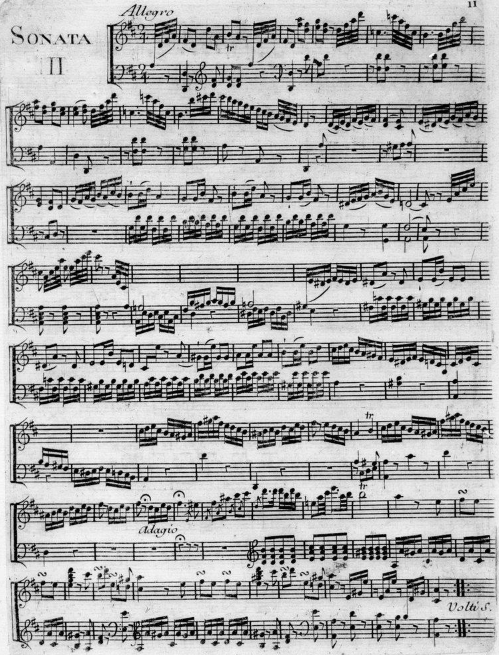
Joseph Haydn wrote around 50 keyboard sonatas (authorship disputes make the true number uncertain). Within them is a large variety of music, spanning from simple divertimenti he wrote in the 1750s and 1760s, to Haydn’s great “London Sonatas” of the 1790s. The difficulty range of these sonatas is wide, with some being suitable for beginners, and others being complex showpieces for a virtuoso. Because of this variety, there is something for everyone within his oeuvre.
For his upcoming birthday, I thought it would be appropriate to share some resources and information for anybody who’s looking for some repertoire, or just for some fun for sight-reading.
Resources
- This webpage contains a 451-page PDF of the complete collection of Haydn’s keyboard sonatas. For those unaware, I got this PDF from IMSLP, a magnificent resource for scores in the public domain. In my personal favorites below, I will be posting a link to the individual sonatas.
Notes on the Sonatas
- From 1766, after taking over as full Kapellmeister for the Esterházy family, Haydn began writing more expressive, experimental music for his own collection (as opposed to the light, galant works he had been writing for the court up to this point). The earlier sonatas are nothing more than simple divertimenti.
- No.51-53 constitute the three “London Sonatas”; These were dedicated to Therese Jansen Bartolozzi, a famous virtuoso in London at the time. These sonatas are great examples of Haydn writing for a virtuoso performer, rather than amateurs and students (of which much of his earlier sonatas are an example).
- The numbering for the sonatas that I am using in this post is according to the Hoboken Catalogue. For example: “Sonata No. 52” would be “Hob XVI:52”.
- There is no clear-cut boundary, however it can be generally stated that the earlier sonatas were intended for clavichord (with a few for harpsichord), while the later sonatas had the new forte-piano in mind.
- One of Haydn’s few models was C.P.E. Bach, so you may be interested in checking out this post of mine on C.P.E. Bach’s Keyboard Sonatas, and possibly this overview I made of him for his recent birthday.
- Several of his keyboard sonatas, including several below, are of uncertain authorship. This mostly applies to the earlier sonatas (No.1, listed below, for example, was quite likely written by another composer).
Personal Favorites
- No. 1 in C Major (1750s) – This is simply a fun, easy piece to play. Perfect for sight-reading. Sheets
- No. 9 in F Major (early 1760s) – Another simple divertimento. Pretty catchy, and another good sight-reading piece. Sheets
- No. 19 in D Major (1767) – Plenty of fun things for the hands to do in the Moderato. Full bodied Andante. The Presto is a series of variations that build in energy and complexity; this movement evokes his symphonic language, in a way. Sheets
- No. 20 in C Minor (1771) – The first work that Haydn titled “Sonata”. Has a taste of the temperament that Beethoven would later embrace (indeed, this sonata has earned the nickname “Haydn’s Appassionata” by some). The steady 8th notes plodding along in the left hand of the Andante create a lovely effect (especially the sections in thirds). The Finale fakes you out a little bit: making you feel like it’s going to be a simple minuet or scherzo, but quickly reveals itself to be an energetic movement in sonata-form; it’s interesting that Haydn gives so much compositional weight to the last movement considering it was written so early (1771) (this would become quite common in Beethoven’s sonatas). Sheets
- No. 22 in E Major (1773) – The Allegro is fun and nice under the hands. The Andante and Minuet are well composed, but nothing special: light entertainment for Prince Nikolaus. Sheets
- No. 23 in F Major (1773) – I love when Haydn uses that little dotted gesture as part of a theme (you can hear is as early as No. 8 in G Major, back in the early 1760s). The whole Allegro is rhetorical in the best of ways; it has real character. The Adagio is very lyrical, and definitely one of my favorites (it would seem like Mozart liked it as well: just compare it to Mozart’s Adagio from his K.280 sonata composed a year or two later; they are even in the same key); the modulation at measure 8 is stunningly gorgeous: check out the Db chord in first inversion, that has it’s ‘F’ lowered to an ‘Fb’; great effect that is a bit ahead of its time. The Presto is simply an example of Haydn’s very fun finales. Sheets
- No. 24 in D Major (1773) – Great Allegro: the spritely opening is deceiving, as it soon gives way to a rich turbulence that takes over. Another excellent Adagio: simple accompaniment with a lyrical melody (it reminds me of the Andante from Bach’s Italian Concerto [BWV 971], which is also in D Minor). Another fun Finale: loose rondo form. Sheets
- No. 26 in A Major (1773) – It is hard to describe the Allegro with words, but it really is great: very quirky, but with unironic seriousness popping up occasionally. Sheets
- No. 27 in G Major (1775~) – Fantastic Allegro that is very fun to play (the way it is written makes it quite well-suited for organ: all the repeated gestures and call/response gestures create great opportunities to play with different registrations). The Minuet/Trio are actually really nice compositions: not just “there to be there”, as many minuet/trio movements from this time period seem to be. The Presto is a catchy set of variations. Sheets
- No. 29 in F Major (1775~) – The Allegro brings to mind a hunting song. The Adagio is lovely: I love the 3rd theme that starts in measure 9 (it’s really pretty the third time it appears, over different harmonies, in measure 29). Interestingly, the Finale is a long minuet. Sheets
- No. 32 in B Minor (1775~) – This one is truly a masterpiece. The Minuet begins in the typical parallel major of B, but the trio is an intense, stormy section back in B Minor. The Finale is great: the main motif carries a lot of energy, and is used very creatively over homophony, as part of canon-like counterpoint, and just as motivic fragments in the development; great motivic creativity that stands up to Beethoven’s later sonatas. Sheets
- No. 33 in D Major (1773) – The Allegro really comes alive when played with some historically-informed ornamentation. The Adagio is very intimate; it is like Haydn himself speaking through the music (it takes a lot of focus to listen to, but it is worth it). The Finale is a set of variations on a light minuet: pretty catchy and fun. Sheets
- No. 34 in E Minor (1780~) – One can hear a lot of the sound Beethoven would later play with in this sonata (Beethoven’s first sonata, dedicated to Haydn, also begins with a “Mannheim Rocket”. Sheets
- No. 37 in D Major (1780) – Lovely Allegro that is shamefully often played way too fast: fun and catchy, and quite musical when played at a reasonable tempo. A baroque-like Largo barges in as the second movement, carrying a somber air that can fill a room. Sheets
- No. 38 in Eb Major (1780) – Interesting opening Allegro: either it is mono-thematic, or the other themes are heavily based on the first theme. The Finale’s structure is pretty much that of a minuet/trio, but its character is not bound to that form in the least. Sheets
- No. 41 in Bb Major (1784) – The Allegro is not to be underestimated; it’s passion and lyricism shine when played musically. Sheets
- No. 46 in Ab Major (1769~) – The opening Allegro has a lot of dignity to it. The Adagio is very sweet: I love the little trill theme at measure 13, especially its use in the development. Sheets
- No. 49 in Eb Major (1790) – One of the first works of Haydn’s “Mature Period”; it is indeed quite forward-looking. The Allegro showcases some creative form techniques: lots of material is introduced in the second key (Bb) in the exposition, most of which returns in a very long development; the coda of the Allegro actually develops transitional material (Beethoven would later go on to use this technique extensively). The Adagio is also quite inventive: it is “quite new… it contains many things I shall analyze for your Grace* when the time comes; it is rather difficult, but full of feeling.” -Haydn. *Marianne von Genzinger, wife of the Esterházy family physician. The Finale is also pretty experimental: it is a minuet/trio, but with two trios, and with interesting use of themes. Sheets
- No. 50 in C Major (1794) – One of the three “London Sonatas” composed for Therese Jansen Bartolozzi. The Allegro’s thematic material is bursting with character. The Adagio is very intimate: some textural material from the Allegro makes an appearance. Sheets
- No. 52 in Eb Major (1794) – Great example of Haydn writing for a professional virtuoso (as opposed to students/amateurs). The Allegro has a majestic, French-overture-like, opening that leads into a theatrical movement with a variety of keyboard techniques, creating a range of effects; extremely fun movement. The Adagio carries a feeling of inevitability: features an ever-present dotted-rhythm, a (not prominent, but still distinctive) repeated-note idea that carries over, seemingly, into the finale. The Finale is a flashy presto that reaches the upper and lower registers of the piano and makes dramatic use of the piano’s dynamics: very fun and virtuosic. The entire piece is a true concert piece, intended to wow. Sheets
Afterthoughts
I listed quite a few of his sonatas in this post due to how difficult is was to narrow my favorites down. There are plenty of gems I did not list, but what I have here is, in my opinion, the best-of-the-best. Haydn’s sonatas are almost always a joy to play: someone I once took lessons with would frequently say “Haydn is like candy” when asked what he thought about playing the sonatas, and I think that opinion holds for a great many of the sonatas indeed.
For those who are familiar with music forms, schema-theory, or partimento, these sonatas are a great deal of fun to listen to, as Haydn constantly challenges your expectations and shows off clever uses of common compositional devices.
I hope that some of these are interesting for those reading, whether for playing, or simply for listening.
Happy exploring~
 Exploring Music
One thought on “Joseph Haydn’s Keyboard Sonatas”