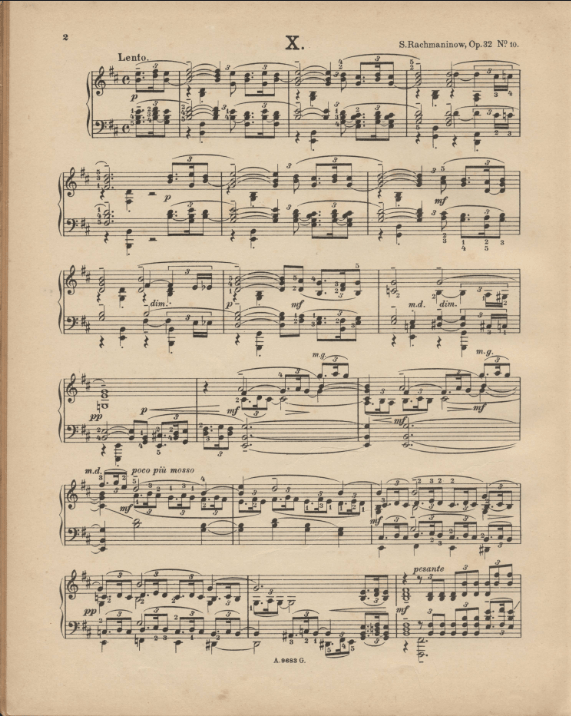
Sergei Rachmaninoff cannot by any means be said to be bound to the piano compositionally (as can be said of Chopin), however he is nonetheless considered by many to be one of the greatest composers for the instrument.
In this post I want to provide a good list of resources for Rachmaninoff’s solo piano works, as well as talk about some personal favorites of mine.
Join me in the comments if you have any favorites of your own you would like to point out~
Resources
- The YouTube Channel Ashish Xiangyi Kumar always puts out incredible content. His videos have very high quality audio and performances, scrolling sheet music, and excellent analyses and discussion in the video descriptions (I implore anyone reading to check out his descriptions). I will list below his collections of Rachmaninoff’s piano works, as they are an excellent resources. (He has a few holes in his Rachmaninoff collection; I will use an alternative video, and me sure to mark it as such, for these cases. Medtnaculus, another very fine uploader, can often fill the gaps.)
- Four Pieces [1887] (Different Uploader)
- 3 Nocturnes [1888] (Different Uploader)
- Op. 3 – 5 Morceaux de fantaisie [1892] (Different Uploader)
- Op. 10 – 7 Morceaux de Salon [1894] (Different Uploader)
- Op. 16 – 6 Moments Musicaux [1896]
- Op. 22 – Variations on a Theme of Chopin [1903]
- Op. 23 – 10 Preludes [1903]
- Op. 28 – Piano Sonata No. 1 [1908]
- Op. 32 – 13 Preludes [1910]
- Op. 33 – 4 Études-Tableaux [1911]
- Op. 36 – Piano Sonata No. 2 [1913; revised in 1931]
- Op. 39 – 9 Études-Tableaux [1916]
- Op. 42 – Variations on a Theme of Corelli (basically La Folia) [1931]
- rachmaninoff.org is an interesting website that is full of articles, biographical details, and a gallery of photographs. It doesn’t seem to be particularly active, but it has plenty of things in its backlog for anyone interested in the composer.
- For those unaware: IMSLP is a great resource for sheet music in the public domain. The site has the vast majority of Rachmaninoff’s music.
Personal Favorites
- Op. 16, No. 3 – As noted in the description, this one makes great use of some interesting chord extensions.
- Op. 23, No. 4 – This Prelude is lovely. The melody rings out incredibly when it is voiced well, and the harmonies that are explored in this prelude are sublime.
- Piano Sonata No. 1 in D Minor – I can recognize the compositional master that the second piano sonata exudes, but there is something about the first one that really connects with me. Kumar does a good job advocating it: “Rachmaninoff’s First Sonata is one of those pieces that feels like its own musical universe: it’s absolutely vast in scope, with at least 4 epic climaxes and a third movement that contains at least 9 distinct musical ideas, yet every moment of music is so thoroughly integrated with every other that it feels totally self-contained, rigorous, complete.”
- Op. 32, No. 5 – This is another Prelude that showcases Rachmaninoff’s mastery of beauty. He can tease out some great effects out of a piano.
- Op. 33, No. 3 – I think Kumar’s comment on this Etude does it justice: “One of my all-time favourites. It begins freighted with complex sorrow and interspersed with distant bell-tolls, before unfurling into an incredibly heartfelt melodic episode built initially around nearly-static harmony. The latter portions of this lyric section involve a rising chromatic melody that Rachmaninoff eventually borrowed for his Piano Concerto No.4.”
- Op. 39, No. 2 – I have a penchant for sea-related pieces, and this one does a great job (noted by Kumar: “LH figurations mimicking the lapping of waves on a shore”). It opens right-off-the-bat with the Dies Irae motif, and it continues to color the whole piece. The “story” that this piece tells is truly enrapturing to me. One of my favorite pieces by Rachmaninoff.
Bonus
- This video by cedarville music does a great job covering some performance issues of Rachmaninoff’s G Minor and Bb Preludes. What he talks about here can(should) be applied to most of Rachmaninoff’s piano works.
- The excellent pianist and content-creator, Nahre Sol, made this video for Rachmaninoff’s birthday last year. She gives a brief overview of Rachmaninoff’s piano techniques, and then uses that knowledge to create a very nice arrangement of “Happy Birthday” in his style. (time-stamp for the performance)
- This is simply a funny routine by the musician-comedy duo “Igudesman and Joo”.
Afterthoughts
Sergei Rachmaninoff left us with a wealth of piano repertoire. His pieces show a complete master of the instrument, and all showcase a very unique, “Rachmaninoff-esque”, character (particularly his later works). Being such a unique composer, he surely isn’t for everyone, but, for those who appreciate him, he can fill your musical world. Even those not enticed by his works may find that they grow on them over the years; his music has a strange way of doing that.
I hope this post proves useful to some of those reading, and I would love to hear any opinions/anecdotes in the comments~
 Exploring Music
One thought on “Rachmaninoff’s Piano Works”