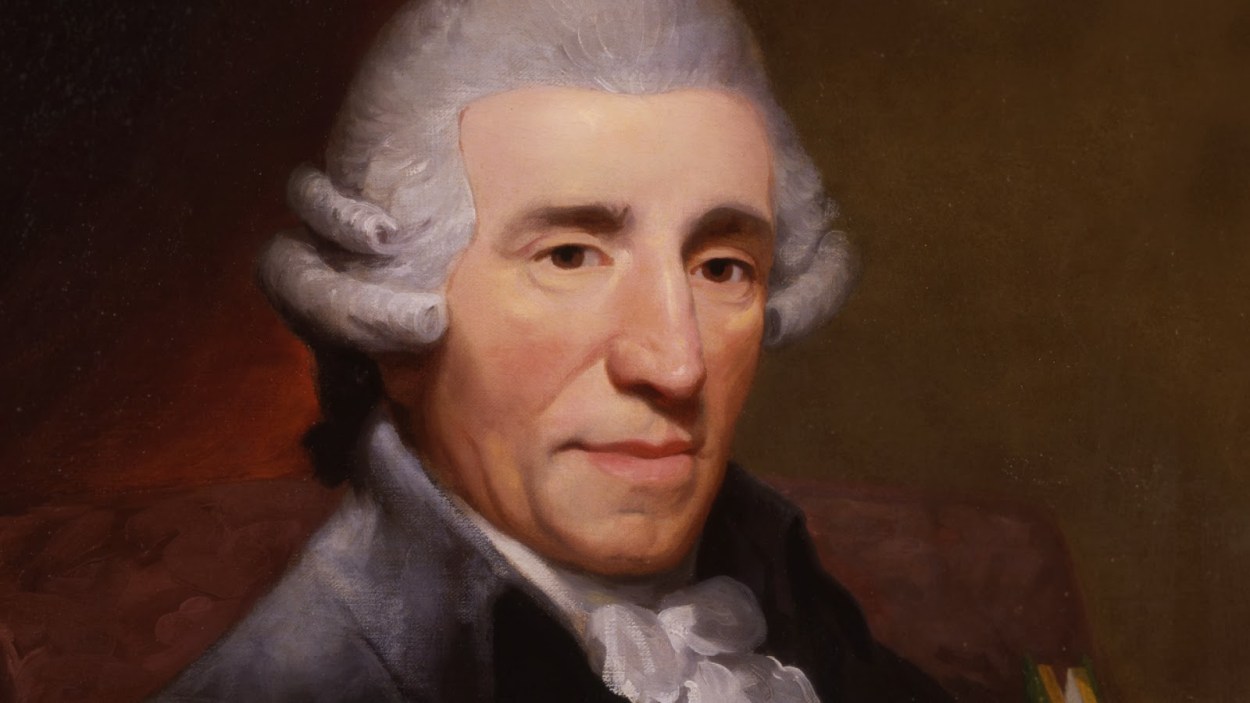
Today marks the 290th birthday of Joseph Haydn (1732-1809), a very creative and innovative composer, and one of the giants in music history. Being so, it is a great opportunity to take a remember his life and discuss his works. I’ll leave a short biography below and discuss some of my favorite works of his.
Biographical Outline
Haydn’s life can easily be split into three parts: Pre-Esterházy, Esterházy employment, and post-Esterházy.
Pre-Esterházy: 1732-1760
- Born in Rohrau, Austria on March 31, 1732
- Sent to Hainburg for musical training at a young age (treated poorly and malnourished)
- Scouted by Georg Reutter and accepted as a choirboy at St. Stephen’s Cathedral in Vienna in 1740.
- After 9 years at the cathedral (still often underfed and treated poorly), Haydn was beaten and expelled (a combination him losing his boyhood soprano voice, as well as an incident involving the snipping-off of a ponytail) (1749).
- Did freelance work in Vienna for a number of years
- Hired as Kapellmeister by Count Morzin (1757) (met and married Maria Keller during this time) before being let go due to Morzin’s money issues (1760).
Esterházy Years: 1760-1795
- Offered a job of vice-Kapellmeister by Paul Anton (Nikolaus I) (Head of the Esterházy family) in Unterlukawitz (1761); promoted to full-Kapellmeister when Gregor Werer, the previous Kaplellmeister, died (1766).
- Contract was renegotiated in 1779, giving Haydn the publishing rights to his compositions; his published works from this point made him internationally popular.
- Nikolaus I died and was succeeded by Anton I (1790); unlike his father, Anton I had little interest in music, and so he dismissed many of the estate’s musicians; Haydn was kept employed (at a greatly reduced salary), and given leave to travel (as his services were no longer essential).
- Haydn made two trips to London shortly after being given leave to travel (1791-1793, and 1794-1795); after JC Bach’s death in 1783, Haydn’s compositions had quickly become among the most popular pieces to perform in London; each trip was very successful, both in terms of reception and in revenue.
Post-Esterházy: 1795-1809
- After returning from his second trip, Haydn moved back to Vienna (1795); Nikolaus II (Anton I had since died) proposed Haydn return as Kapellmeister, and Haydn accepted part-time (summers).
- The next 8 years saw the completion of several major works: 6 masses; The Creation (1798); The Seasons (1801); The Emperor’s Hymn (1797); His last major, his 6th Mass, was completed in 1802.
- From 1803 until his death Haydn’s health gradually, then quickly, declined.
- A performance of The Creation was put on in his honor in 1808; many of the big names of the day were involved (Salieri, Beethoven, etc.).
- Haydn died on May 31, 1809, shortly after Napoleon’s invasion of Vienna.
Compositional Output
Haydn was an extremely prolific composer. His ouevure includes 104 symphonies, 68 string quartets, 50~ keyboard sonatas, 50~ divertimenti, 30 string trios, 150~ trios/duos for baryton, 40~ keyboard trios, 15 masses, 23 cantatas, 13 operas, hundreds of songs (both original and arrangements), and many other pieces besides.
He is known as the father the string quartet, and indeed did much for the development of the genre from simple background divertimenti to fully-fledged works for connoisseurs meant to be taken seriously as art.
His works had a dramatic impact on Mozart and Beethoven (though Beethoven famously shied away from the fact at times) and even later romantic composers such as Brahms (who thoroughly studied Haydn’s string quartets).
In discussing specific works below, I will use Hoboken numbers unless otherwise specified, so as to avoid any confusion. Symphony numbers, for example, are preceded by “Hob. I:”, so “symphony No. 39” would be “Hob. I:39”.
Personal Favorites
Keyboard Sonatas
- I discuss his keyboard sonatas in detail in this post.
String Quartets
In my opinion, Haydn’s string quartets are where he can be best judged as a composer, and they are far and away my favorite works by him.
Op. 20 (The “Sun” Quartets) (1772) marks a revolutionary evolution of style (hinted at in the earlier Op.17 [1771]).
This section, however long, will be shorter than I would like. I plan to make a future post dedicated solely to his string quartets.
- Op.1, No.2 in Eb Major; Hob. III:2* (late 1750s) – One of his earliest works, but already showing a very intuitive understanding of composition. The first menuetto practically begs you to move, or at least sing along. The Adagio is in binary-aria form, with the 1st violin as the soloist; the scoring for this would fit right into an opera, particularly the pizzacatos–it’s very easy to imagine a singer on stage while listening to this. *henceforth, will be listed as (2), to save space
- Op.2, No.4 in F Major (10) (late 1750s) – The opening presto features an interesting unprepared modulation after the D Major cadence in the development. The Adagio is divine: extremely beautiful. The trio section of the second menuetto has some interesting rhythmic effects.
- Op.9, No.2 in Eb Major (20) (1769) – Harmonically creative opening moderato (I love the deception at measure 30: I64 – i64 – V65/bVI – bVI). The Adagio is another beautiful solo for the 1st violin: a very nice texture is created by alternating 8th notes and 8th rests between the viola and the cello.
- Op.17, No.2 in F Major (26) (1771) – Lyrical and energetic opening moderato with an inventive development. Interesting swaying rhythms in the Menuet. The Adagio is abound with passionate “vocals” from the 1st violin: measures 40-52 are absolutely transcendent; such incredible harmonies. Fun Finale with some playful sequences.
- Op.17, No.4 in C Minor (28) (1771) – The opening Moderato is in sonata-form, and carries a serious/emotional character Haydn often saves for his C Minor works: the Abm section of the development is great. The Adagio utilizes C.P.E. Bach’s technique of a varied reprise.
- Op.20, No.2 in C Major (32) (1772) – The Moderato is a great movement: the dialogue between the 1st violin and the cello in the opening of the development section is lovely. The cello solo after the Adagio’s short opening is gorgeous, and the 1st violin’s solo in Eb Major at measure 34 is like the sun peaking through what used to be storm clouds.
- Op.20, No.4 in D Major (34) (1772) – The Adagio is a passionate set of variations: the second half of the theme is very poignant; just incredible. The Finale uses Romani scales/melodies, and is simply a blast: very exciting.
- Op.33, No.1 in B Minor (37) (1781) – The opening Allegro is mono-thematic, but the extensive development more than makes up for that: it begins with a D Major chord [relative major], just like Brahms’ Op.115; Brahms studied Haydn’s Op.20 and Op.33 extensively. The Andante is very pleasant, and showcases some interesting Shostakovich-esque chromaticism at measure 25. The Finale has some Italian-baroque influence to it: driving, rhythmic energy and dialogue-heavy; much like a Vivaldi violin concerto.
- Op.33, No.2 in Eb Major (38) (1781) – Very delightful opening Allegro. The trio section of the scherzando is very dancable and very singable: one of my favorite trio sections. The Finale is a laughable good time: listen to it without reading the score-it won’t fail to bring a smile to your face.
- Op.33, No.5 in G Major (41) (1781) – The Largo is a beautiful, cantabile movement that seems to be directly inspired by the operas of Gluck. The Finale is a catchy siciliano, with a few variations and a joyful presto coda.
- Op.50, No.4 in F# Minor (1787) – One could see this quartet as exploring the relationship between major and minor modes and modulating when to modulate between them (see the comments under the video for more on this). The Andante is a rondo/variation movement that features some very sublime harmonies. The Minuet/Trio gracefully shows of the best of the 1780s galant balance, but is by no means boring. Haydn uses a fugue as the Finale, and it is certainly an impressive one.
- Op.54, No.2 in C Major (1788) – This one makes the list due to the incredible Adagio. It demands your attention, then leaves you hanging in just few minutes, and your left in the midst of a minuet wondering what just happened. The Trio section of said minuet is notable, and almost seems like a bridge between the adagio and minuet.
- Op.55, No.2 in F Minor (1788) – The second movement Allegro captivates me from the very first measure, and showcases some amazing craftsmanship; it has everything a good string quartet should have, and, just when your satisfied and think good idea of what is going on, Haydn throws in a masterful fugal development section. The Minuet is entrancing, and has a rhythmically interesting anacrusis. The Presto Haydn closes this quartet out with is one of his signature finales that beg for you to move along to it.
- Op.64, No.5 in D Major (1790) – Beautiful opening Allegro; lovely, singing themes. Lyrical, painfully gorgeous Adagio; the short minor section is very intimate embrace, and it feels like it lets you go as you float back into the major section. After an easy going Minuet, Haydn moves into a Trio which interesting features some quite developed counterpoint. Firey Vivace as the finale, that breaks out into fugal counterpoint in the middle section.
- Op.71, No.2 in D Major (1793) – After a short introduction, Haydn launches into one of the most addicting Allegro movements I’ve heard; it begs to be sung and moved to. The Andante takes its time, but really communicates true beauty.
- Op.76, No.1 in G Major (1797) – Themes are playfully and creatively passed around between the instruments in the opening Allegro. The Adagio has some beautiful chromaticism in it, and the first violin and cello share some sweet dialogue throughout the movement; each return of the opening theme is more and more satisfying. The Finale features very nice contrapuntal writing (like many of Haydn’s late finales); interesting effect at measure 94 where the violins trade off notes.
- Op.76, No.4 in Bb Major (1797) – It may be a stretch, but the Adagio does seem to me to have the same kind of character as Liszt’s later religious works; it is more than beautiful, it’s sublime. The Minuet/Trio of this quartet really stands out as well
- Op.77, No.2 in F Major (82) (1799) – The opening allegro is fantastic music not only to listen to, but also to study. Haydn’s weaving of themes and his modulations are genius here, and it takes some time and attention to notice everything he does in this movement. A cute Minuet/Trio follows that immediately shows some fun writing when the cello begins it playing its bouncy fifths and creates a kind of duple meter effect. Starting off the Andante with only the first violin and cello provides a refreshing and sweet atmosphere, and allows for such a sublime moment when the other two instruments subtly enter the music here; this movement alone would still make this quartet one of my favorites. This moment before the coda in the finale where the first violin and the cello have a little dialogue put a smile on my face; using the huge range of a string quartet’s instruments for some fun.
Symphonies – Hob. I:x
- No. 39 in G Minor (1768) – This is an early work, but Haydn’s signature creativity is very present. This is a very engaging symphony, and very well-constructed. [Read the video description].
- No. 45 in F# Minor “Farewell” (1772) – One of his most famous symphonies, and not without good reason. It is a very fine symphony, with quite an interesting story behind it.
- No. 49 in F Minor (1768) – One of his incredible Sturm und Drang works. Also his last symphony in the “sonata da chiesa” form, which is (in my opinion) quite a shame. [Read the video description].
- No. 59 in A major “Fire” (1769) – This one completely deserves its nickname. [Again, great info in the video description].
- No. 83 in G Minor “La Poule” (1785)- One of the 6 Paris Symphonies commissioned by the Chevalier de Saint-Georges. This one is definitely in my list of favorite symphonies of all time; it has an extremely fun and engaging opening, a very graceful Andante, a charming minuet/trio, and one of Haydn’s signature Finales. [Good info in the description].
- No. 84 in Eb Major “In Nomine Domini” (1786) – One of the 6 Paris Symphonies commissioned by the Chevalier de Saint-Georges. This symphony represents the best of the 1780s music world; Haydn was really showing his compositional talent in this one. [Good info in the description].
- No. 88 in G Major (1787) – Yes, the famous No.88 definitely has a place here. It is hard for me not to see Leonard Bernstein’s eyebrow conducting when I hear the finale.
- No. 94 in G Major “Surprise” (1791) – Even besides the cheekiness in this one, it is a very well-composed work.
- No. 104 in D Major “London” (1795) – This work is really a prequel to the 19th century. It’s incredible how much Haydn’s symphonies evolved from his earliest 1760s trifles, to this masterpiece just 30 years later.
Piano Trios
- Hob. XV:13 (1789) – The opening Andante of this one is a lovely set of variations.
- Hob. XV:25 (1795) – I’m a particular fan of the very fun Finale.
Concertos
- Cello Concerto in C Major Hob.VIIb: 1 (early 1760s) – The cello can be a fantastic solo instrument, and Haydn does a great job in this concerto of providing material to prove that statement.
- Keyboard Concerto No. 11 in D Major Hob. XVIII:11 (<1782) – One of the staples of pianists for keyboard concertos, and for good reason. It may be a more light, galant work, but it is still very well constructed and very fun, both to play and to listen to.
Quotes
“I was cut off from the world. There was no one to confuse or torment me, and I was forced to become original.”
Joseph Haydn
“I listened more than I studied… therefore, little by little, my knowledge and ability were developed.”
Joseph Haydn
“I was never a quick writer, but composed with great care and efforts.”
Joseph Haydn
“If you want to know whether you have written anything worth preserving, sing it to yourself without any accompaniment.”
Joseph Haydn
Bonus
I mention in my post on his keyboard sonatas that “Haydn constantly challenges your expectations and shows off clever uses of common compositional devices”.
- The Youtube Uploader Richard Atkinson has put out some relevant videos: on rhythmic tricks used to humorous effect and on some hilarious, but masterful counterpoint in Haydn’s Op.64, No.1 String Quartet.
- Haydn and Partimento
Afterthoughts
Joseph Haydn was a giant of his time, and even though he was starting to be dismissed by the mid-19th century, it is undeniable that his massive influence lived on in most of the major composers. He was being more honest than he perhaps realized when he said he was “forced to become original”, and yet he was also a master at internalizing all kinds of other styles into his own.
He has such a large oeuvre that what I touched upon in this post is just scratching the surface, and I am sure I neglected many pieces (entire genres even) that many reading this post have as their favorites. With that in mind, I would love to hear an recommendations in the comment section. I can say with confidence that nearly every musician has some good experience with Haydn in their memories; it would be great to see them all here on his birthday.
Otherwise, I encourage even non-musicians to explore a few of his works; it is well worth it to do so.
Happy listening~
 Exploring Music