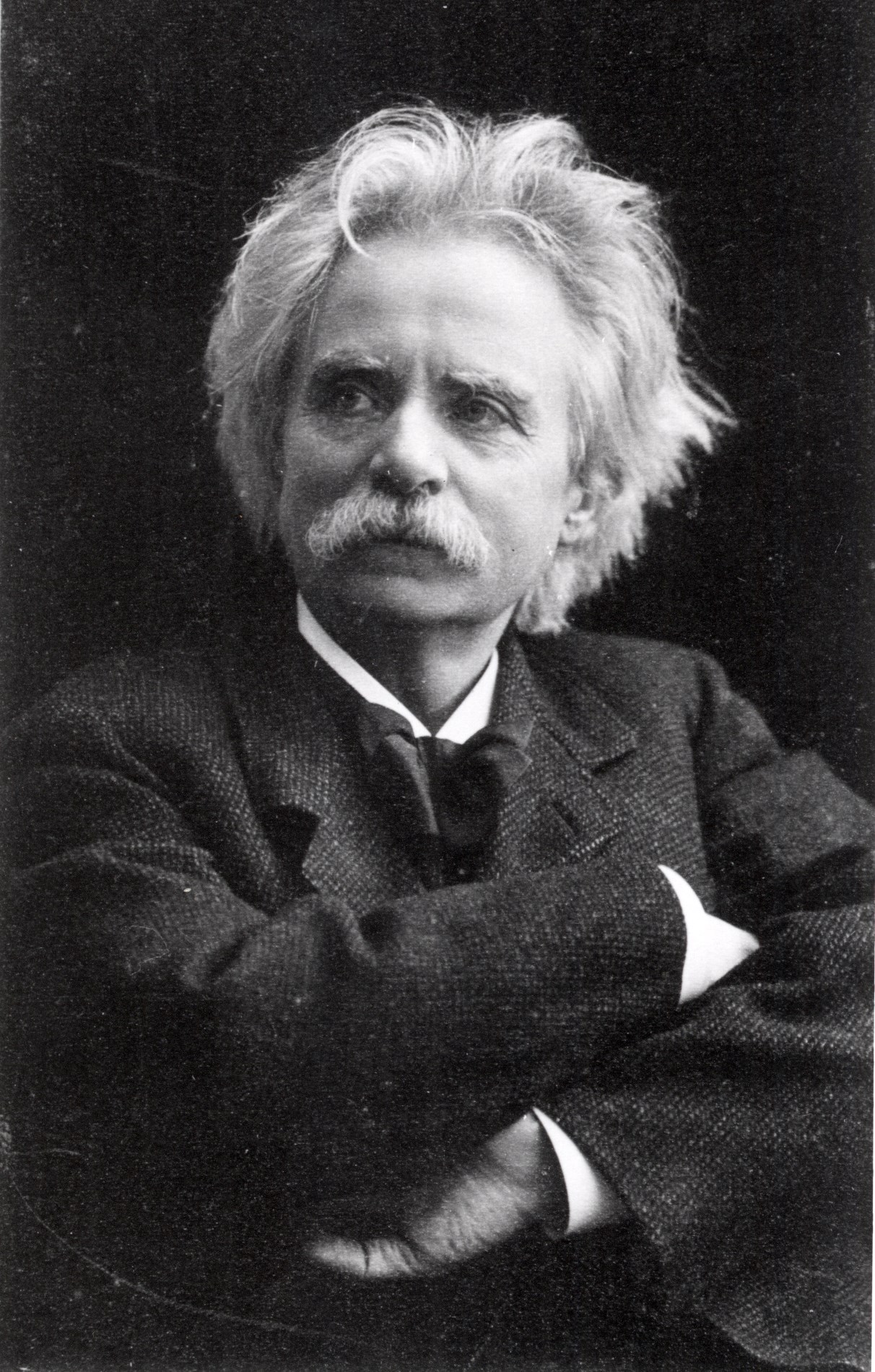
Edvard Grieg is a composer I connect with more than almost any other. His music holds a special place in my heart along with the music of my other adored composer, C.P.E. Bach.
Below is a short biographic outline of the composer, and then I discuss some of my favorite works by him.
Biographic Outline:
- 1843: Born in modern-day Bergen, Norway on June 15, 1843.
- 1858: At the recommendation of Ole Bull, who recognized Grieg’s talent, he began studies at the Leipzig Conservatory.
- 1860: Came down with tuberculosis. It was a serious diagnose that cost him one of his lungs. This would follow him the rest of his life, and he would frequently develop respiratory infections.
- 1862: Graduated from the Leipzig Conservatory and moved to Copenhagen, Denmark where he stayed for about three years. During this time he studied with Niels Gade and he became acquainted with other Danish composers, and, notably, the Norwegian composer Rikard Nordraak.
- 1866: Grieg returned to Norway, and settled in modern-day Oslo.
- 1867: Married Nina Hagerup.
- 1869: Spent a winter studying in Rome on a travel grant (that he acquired with a recommendation from Franz Liszt, who was an admirer of Grieg’s compositions). There he met other composers of the time, and, notably, Franz Liszt (who reviewed Grieg’s first violin sonata, and later in the spring, Grieg’s piano concerto with much pleasure).
- 1887: Grieg meets Brahms and Tchaikovsky in Leipzig. This is a favorite story of mine in Grieg’s life, as it reveals so much about his personality (as well as Brahms and Tchaikovsky). It is a first-hand account of the meeting by Anna Brodsky. This is such a nice quote: “The situation might have become difficult, but at that moment the door was flung open, and in came our dear friends Grieg and his wife, bringing, as they always did, a kind of sunshine with them.”
- 1870s, 1880s, 1890s, 1900s: Grieg and his wife were very fond of traveling, and spent time all over Europe composing, studying, conducting, performing, etc. (they were universally well-received). Hitting every point in this part of his life would make this section much longer than I’d like it to be.
- 1907: Grieg succumbs to his ill health and passes away on September 4, 1907 at the age of 64.
Personal Favorites:
Piano Works
Grieg composed 10 volumes of character pieces he named “Lyric Pieces” between 1867 and 1901. Each volume contains 6-8 short pieces in which Grieg tries to capture a particular feeling or subject. My favorite are listed below:
- Book 1, No. 1: Arietta (1867) This is the piece that opens the entire set. A wistful melody that hangs in the air is sung over a ghostly accompaniment. This is a piece that never quite leaves your mind. It had the same effect on the composer himself; it was one of his own favorite melodies, and he reused it in later works as well.
- Book 1, No. 5: Popular Melody (1867) This is basically a mazurka laced with Grieg’s Norwegian character.
- Book 2, No. 6: Elegie (1883) Warm remembrances are interspaced into the typical somber mood of an elegie. The lone “E” note that often overhangs chords creates a stunning effect (see measure 4 as an example).
- Book 2, No. 8: Canon (1883) This is a two-voice canon at the octave with simple accompaniment, yet it totally avoids sounding like a dry counterpoint exercise. It is very fun and engaging to listen to (a bit tricky to play well, though).
- Book 4, No. 3: Melody (1888) This one sits in my mind as a reflection of the aftermath of a great event.
- Book 4, No. 5: Melancholy (1888) Grieg’s choice of rhythms in this piece do an incredible job of helping to set them mood he is going for. This piece requires a sensitive performer to shine.
- Book 4, No. 7: Elegie (1888) Another elegie, but this one is less sad and rather more enigmatic. Descending into the comprehension of death.
- Book 6, No. 3: Illusion (1893) The slow, repeating octaves help a lot with the trance-like effect of this piece.
- Book 8, No. 2: Peasant’s Song (1897) It is interesting to have so much chromaticism under such a folk-like melody.
- Book 8, No. 5: Ballad (1897) This piece is full of absolute wonder.
- Book 8, No. 6: Wedding Day at Troldhaugen (1897) This is an iconic, celebratory piece that has been heard by many, and does not require an endorsement of its quality. Grieg wrote it for his 25th wedding anniversary in 1896. Troldhaugen is the name Grieg gave to his home where he lived with his wife, Nina.
- Book 10, No. 7: Rembrances (1901) A nostalgic callback to where Grieg started with the Lyric Pieces 34 years previously. This time he structures it in the manner of a waltz.
Besides his Lyric Pieces, Grieg wrote a considerable amount of other character pieces spread across a number of opuses. Compared to his lyric pieces, these other short piano works tend to be more explicitly connected to his Norwegian heritage. This is more and more evident as his composition career goes on.
I am listing my personal favorites below in chronological order, so they can serve as an interesting journey through Grieg’s development of his own unique Grieg/Norwegian style.
- Op. 1, No. 4 (1861) This piece, like the rest of Opus 1, is very Schumann-esque. Grieg was finishing up his studies at the Leipzig conservatory at the time, and this piece is very much in line with the prevailing style in Leipzig at the time. A quote from Grieg himself about his time in Leipzig may offer some good context here: “…I left Leipzig Conservatory just as stupid as I entered it. Naturally, I did learn something there, but my individuality was still a closed book to me.” The piece itself is certainly not on the level of Grieg’s later artful works, but it is still very well composed and demonstrates a thorough understanding of composition (Grieg was just 19 years old when he wrote this).
- Op. 6, No. 4 (1865) Already we have a piece that in just a few measures, one could immediately the “Grieg” touch in the music. This is a fun Norwegian dance that Grieg wrote while living in Copenhagen, Denmark.
- Op. 17, No. 8: The Pig (1869) I have no idea why I can connect with this so easily, or so easily imagine a brown pig walking around a farm absorbed in its own perception of the world, but I love this piece.
- Op. 17, No. 10: The Wooer’s Song (1869)
- Op. 17, No. 16: I Know a Little Maiden (1869) This can be heard as expressing so many different emotions about the “little maiden”: love; tragedy; concern; even malice (a la villain song).
- Op. 17, No. 22: Cow Call (1869) Really does feel like the end of a long day – everything winding down. The music itself is very sweet, measure 13 is almost painfully so.
- Op. 17, No. 25: The Raven’s Wedding (1869)
- Op. 28, No. 1 (1864) Such an addictive melody in the opening section; before you have a chance to grow tired of it, Grieg throws in some lovely, flowing sequences in the middle sections. Then the opening melody comes back to close out the short piece.
- Op. 28, No. 2 (1874) Chromatic lines seem to pull you along through the music like the gentle heave-ho of a rope.
- Op. 28, No. 3 (1876) This one is simply a fun, swaying waltz. The middle section in A Minor is a bit more characteristically “Grieg”.
- Op. 28, No. 4 (1878) The most Norwegian of Opus 28. The middle section starting at measure 25 with the D-flat pedal-point has a wonderfully vivid atmosphere – orchestral; joyfully walking down a cheery main street.
- Op. 29, No. 1 (1878) The first 20 measures are totally hypnotizing. Then the piece is captivating and thrilling until the end – like being pulled along by the hand through a tumultuous scene.
- Op. 34, No. 1: The Wounded Heart (1880) This was originally a song with piano accompaniment (Op. 33, No. 3). Grieg later arranged it for solo piano, as well as for a string orchestra. It is remarkable how well the music works in all three arrangements. This is a poignant and haunting piece of music.
- Op. 41, No. 1: Cradle Song (1884) This too was originally a song with piano accompaniment (Op. 9, No. 2). This is somber and reflective music that perfectly suits the lyrics of the song (see the description of the YouTube video for a translation).
- Op. 41, No. 4: My Love She was so Pure (1884) Another transcription (Op. 18, No. 2). A short statement – this is like a brief reflection of a dead lover when she suddenly comes to mind throughout the day.
- Op. 52, No. 4: Solveig’s Song (1890) Those who are familiar with Grieg’s Incidental Music for Peer Gynt will recognize this as a transcription, and a very fine one at that. It is wonderful as a pianist to be able to sit down and play this beautiful arrangement when this music is stuck running through one’s mind.
- Op. 63, No. 1: In Folk Style (1895) This music feels unbelievably special to me and I do not understand why. I physically feel it in my heart. This is a transcription of music for string orchestra by the same Opus number. Something about the piano arrangement really connects with me on another level, however.
- Op. 63, No. 2: Cattle Call (1895) So touching as to be emotionally overwhelming.
- Op. 66: 19 Norwegian Folk Songs for Piano (1896) It somehow feels wrong to pluck out individual pieces from this opus; it definitely feels like one big cycle, and should be preserved as a whole. The description of the linked video has some good information, but I really implore any readers to sit down and give this opus your attention for half an hour; there is a lot of incredible subtleties, and it is definitely worth the attention. I plan to make a post dedicated solely to this opus in the future.
- Op. 72, No. 8: Myllarguten’s Wedding March (1903) A different take on a wedding march. Based on a song written by the famous fold musician Myllarguten about a women he loved who ended up marrying another man.
- Op. 72, No. 17: The Girls from Kivledal (1903) This is a very interesting pairing of rich, modern harmony paired with a simple folk melody.
In 1884, Norwegians were preparing to celebrate the 200th birthday of Ludvig Holberg, a Bergen, Norwary-born Danish writer and philosopher. Grieg, also Bergen-born, was pleased to take charge of much of the planned celebration in Bergen, which included this “Suite i gammel stil” (“Suite in olden style”) dedicated to Holberg, now known simply as the Holberg Suite.
- Op. 40: Holberg Suite (1884) This suite takes direct inspiration from the typical keyboard suites of the early 18th century, but is clearly in Grieg’s modern style. The description of the linked video has some great information. The suite opens with an immediately gripping prelude, but I have always been enamored by the air – of the five movements, it is probably the most in-line with an 18th century style, but Grieg manages to artfully insert his own voice. The result is sublime.
Orchestral
Grieg didn’t write a massive amount of orchestral music, but some of the things he did write I quite like.
- Op. 46 and Op. 55: The Peer Gynt Suites (1888-1891) It seems like Grieg extracted the very best from the incidental music he wrote for Peer Gynt to create these orchestral suites. I am particularly fond of The Death of Aase and Solveig’s Song.
- Op. 64: Four Symphonic Dances (1897) Grieg does an amazing job at mood-setting in these pieces. They still sound fresh and modern even today – I could imagine some of this music accompanying movies scenes. I wouldn’t say they are “similar”, but I get a similar feeling from these as I do from some of the music accompanying Studio Ghibli movies. I am particularly fond of No. 2.
- Op. 16: Piano Concerto in A Minor (1868) I do not think that this piece needs an advocate. With the possible exceptions of Morning Mood and In the Hall of the Mountain King, this concerto is certainly the most well-known of Grieg’s works. The performance I linked it a particularly fine one, I believe.
Chamber
- Op. 45: Violin Sonata in C Minor (1887) Grieg masterfully gives this pieces for piano and violin the feel of a full violin concerto. This is a wonderful violin sonata, and an interesting re-visitation of larger forms by Grieg. It is the third, and last, violin sonata written by the composer, and completely outshines the previous two in my opinion.
Songs
Grieg wrote an astounding number of songs with piano accompaniment. Nearly half of his entire compositional output would fall in this category. Sometimes these songs are based on a folk melody, sometimes an original melody by Grieg; sometimes the lyrics are original, sometimes they are taken from poems, stories, or folk songs. The majority were written with his wife, Nina Grieg, in mind as the performer.
This is not a genre I am overly familiar with, but for any readers who are vocalists or fans of songs, I assure you there are plenty of gems in Grieg’s oeuvre for you. I have already linked to a handful above that were later transcribed for solo piano.
Choral
Choral works are not what typically come to mind when one thinks of Grieg, but he did write a modest amount of music for the choir.
- Op. 74, No 1: How fair is thy face (1906) This is a great recording of a sublime piece. It is intriguing to think about what music Grieg may have written if he had dedicated more time to this style, but I am simply thankful he left us with what he did.
- Op. 74, No. 3: Jesus Christ our Lord is Risen (1906) This is incredible music to set to the text. One can feel how seriously Grieg took these compositions.
Quotes
Artists like Bach and Beethoven erected churches and temples on the heights. I only wanted to build dwellings for men in which they might feel happy and at home
Edvard Grieg
When we are young, friends are, like everything else, a matter of course. In the old days we know what it means to have them.
Edvard Grieg
I am sure my music has a taste of codfish in it.
Edvard Grieg
Afterthoughts
Grieg is easily overlooked if one does not take the time to get to know him and explore his music. For those that do, however, there is a whole world in Grieg’s music; a world unto itself, and it stands out even among the other Norwegian nationalist composers of the time.
Grieg was a modest man, and much of his music reflects that. With just a single piano, and a few minutes of your time, Grieg can delight your soul with any number of his lovely piano character pieces. Though “modest” in scope, Grieg composed his music with such artistic seriousness as to elevate his works far beyond simple “fun pieces”, which they still are.
I hope I have been able to do the composer justice in this post, and inspire a little in others what I feel every time I listen to Grieg’s music.
If you have any favorite pieces of his you’d like to mention or discuss, please leave them in the comments!
If you’re new to Grieg’s music, then I wish you happy exploring~
 Exploring Music