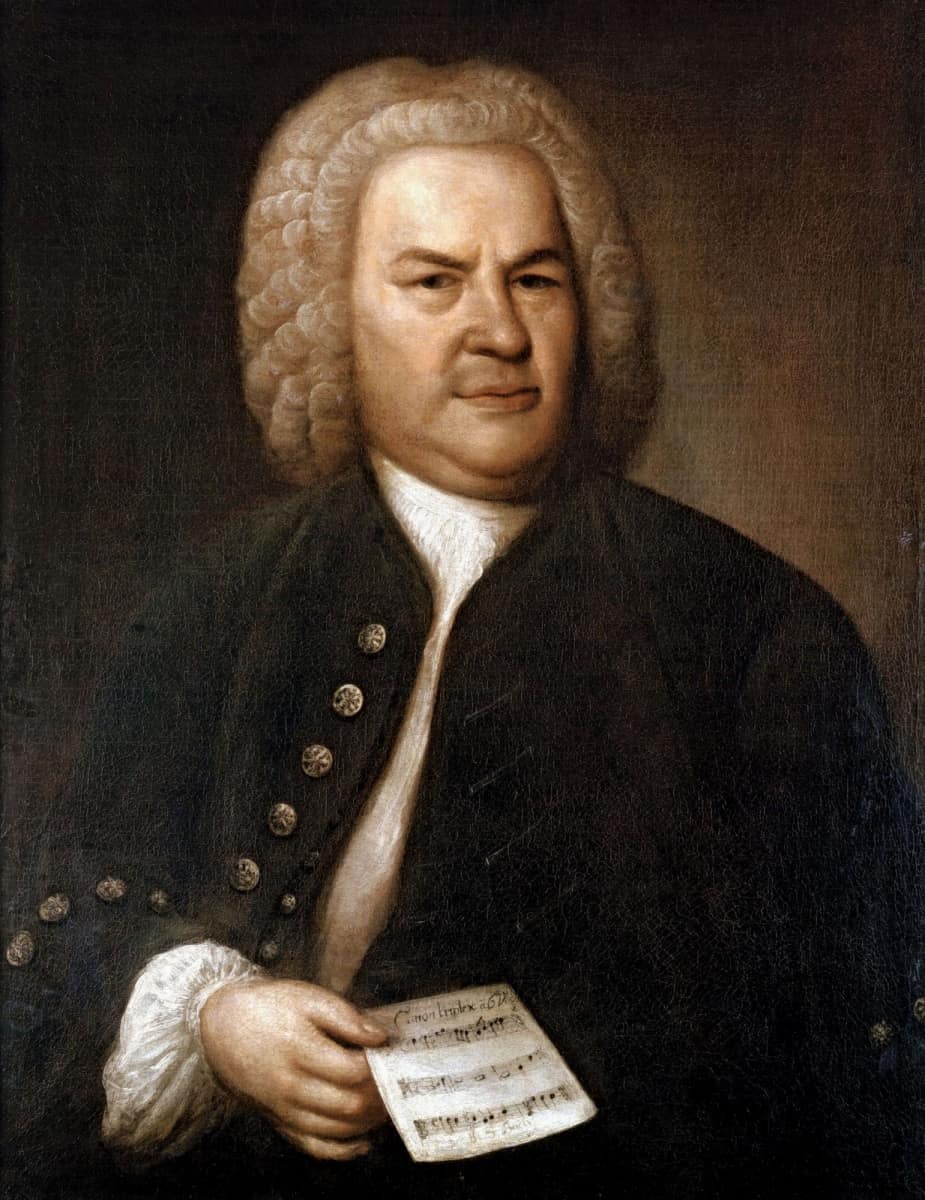
Today marks the 337th birthday of Johann Sebastian Bach, without a doubt one of the tallest standing giants on whose shoulders stand a significant portion of our musical canon. What better time than his birthday is there to take a look at his life and his works?
I will leave a short biography below, share some resources, and share some of my favorite pieces of his. I welcome everyone reading to join me below, and share their own anecdotes or favorite works in the comments.
Biographical Outline
Bach had a fairly mobile life, and spent short periods in many places. For the sake of brevity, I will gloss over the shorter periods, and focus more on the more significant ones.
1685-1703
- Born in Eisenach, Saxe-Eisenach on March 31, 1685. *The calendar at the time would have read March 21, 1750; this is due to difference in the Julian and the Gregorian calendar systems*
- The Bach family was very musical: his father, many uncles, many cousins, and his siblings were all professional musicians to some degree.
- His mother died in 1694, and his father died shortly thereafter; Sebastian Bach moved in with his older brother, Johann Christoph Bach, who lived in Ohrdruf (1695).
- Enrolled in the St. Michael’s School in Lüneburg in 1700.
1703-1723
- After graduating (1703), Bach obtained a position as a musician of Duke Johann Ernst II’s court in Weimar; became the organist at the “New Church” (now the “Bach Church”) in Arnstadt later that same year. (this post is the setting of two famous stories of Bach: the incident with the “nanny-goat bassoonist”, as well as his two week leave to travel in which he walked 280 miles [450 kilometers] both ways on foot to visit Buxtehude [he was absent for 4 months during his “2 week” leave].)
- Spent 2 years in Mühlhausen as organist at the Basius Church (1706-1708); he met and married Maria Barbara Bach four months after his arrival
- Returned to Weimar to take the post of organist at the Ducal Court (1708-1717): became Director of Music (1714), which entailed a monthly composition of a cantata; spent a considerable amount of time transcribing Italian works during this period; wrote the English Suites during this period; wrote the preliminary works that would become the Well Tempered Clavier during this period.
- Dismissed from his Weimar post in 1717, and even jailed for a day over his stubbornness over the dismissal.
- Hired as Kapellmeister for Leopold, Prince of Anhalt-Köthen in Köthen (1717-1723): Leopold did not require much music for services, so much of Bach’s time was spent on secular compositions during this period; Bach’s attempted visit of Handel (a 22 mile [35km] walk away) happend during this time (1717)-Handel wasn’t in town; his first wife died (1720); he met and married Anna Magdalena Wilcke in 1721; completed the Brandenburg Concertos by 1721; completed the first book of the Well Tempered Clavier in 1722.
1723-1750; The Leipzig Years
- Appointed Thomaskantor of the Thomasschule at the St. thomas Church in Leipzig (1723): wrote the majority of his known cantatas within his first 3 years here; completed the French suites within the first 3 years as well.
- Became director of the Collegium Musicum (1729-1737): many of his secular compositions during this period were intended for this organization, to be performed at the famous Café Zimmermann in Leipzig.
- Published his four Clavier-Übung during his time in Leipzig (discussed in the “Compositional Output” section).
- Composed the bulk of his Mass in B Minor in the mid-1740s
- Completed the second book of the Well Tempered Clavier in 1742
- His famous visit to Frederick II of Prussia in Potsdam occurred in 1747. This is an entertaining dramatization of the meeting (emphasis on the “dramatization”, but it is fun nonetheless.) (There are subtitles in the options of the video.) This is an EXCELLENT score video of the music Bach wrote in response to this meeting; it presents the history/background-information, as well as break down what is actually happening in the music.
- Began a large part of his “The Art of Fugue” in 1742, which he would prepare for publication and work on until his death.
- Bach, becoming blind, had eye surgery performed by the fraud John Taylor in early 1750; JS Bach would die several months later from infection on July 28, 1750.
Compositional Output
How can I even begin talking about Bach’s compositional output…
This is a rare instance where I feel like simply dropping a link to a Wikipedia page is the best thing to do. This is a page about Bach-Werke-Verzeichnis [BWV] “Bach Works Catalogue”. This catalogue is the standard way of organizing Bach’s many works, and this page contains information on all 13 categories within the catalogue, and endless rabbit holes to fall into.
His four Clavier-Übung I mentioned earlier are as follows:
- I – The 6 Partitas (1726-1730; published 1731)
- II – The Italian Concerto and the French Overture (1735)
- III – The German Organ Mass (1739)
- IV – The Goldberg Variations (1741)
His output is stunning not only due to its volume and variety, but also because each piece that we have is so packed full of music. There are few works by JS Bach that we have that are simply trivial, throw-away pieces; most are all so well-composed, so full of craftsmanship, that nearly each piece invites one to devote themselves to the study of it.
Resources
- gerubach is a YouTube channel that, as far as I can tell, is incredibly run by a single person. The ultimate goal of the channel is to have a video with scrolling sheet music for every single composition by Bach. This channel is truly a great resource.
- Netherlands Bach Society is another channel with a similar goal. However, this group focuses on creating new, extremely high quality (both in audio/video and in performance) recordings of every Bach piece. Their performances are all historically informed. They have some of the absolute best performances of Bach’s cantatas and Passions I have ever heard. Along with nearly every performance, they upload a sister-video that is an interview with some of the performers; these videos are always very informative and interesting.
- Voices of Music does not focus soley on Bach, but rather all of the baroque repertoire. They are another historically informed ensemble. They have a great deal of Bach recordings, and their videos are of very high quality.
- Ashish Xiangyi Kumar has only a small amount of content relating to Bach, but it is of such high quality that it deserves a mention. The videos feature scores, high-quality audio, informed analyses, and great discussion in the descriptions.
- For those few unaware, IMSLP is an incredible source for sheet music. The site has nearly anything you could want that is in the public domain.
Personal Favorites
It will take a lot of discipline to keep this section short. I will also skew away from the more well-known pieces; I personally adore much of the WTC, but so do most others, and they are already aware of the pieces. The same goes for many other works. (I do have future plans for a post solely dedicated to the WTC, that goes into more depth, incidentally).
- BWV 532 – This Prelude and Fugue for organ has some of the most incredible dissonances I’ve felt. I really urge you to listen to this with good studio headphones or loud speakers; feel the power of the instrument-the adagio section of the prelude will hit you like a ton of bricks.
- BWV 572 – Another great organ piece, this time a Fantasia. The Grave segment is great. If you don’t want spoilers, stop reading: the final cadence of the Grave section is quite the surprise, a deceptive C#dim7 chord.
- BWV 578 – This organ fugue has a very catchy subject, and deserves its fame. This piece (and this video) is great for teaching; it’s a great way to introduce beginner students to the concept of counterpoint, as they can “see” the voices, and the subject is so memorable and distinctive.
- BWV 1023 – This violin sonata is great. The Adagio is so beautiful.
- BWV 1016 – Another stunning violin sonata. The second Adagio is really something else. If you listen to the harpsichord parts, you’ll realize this is actually a disguised trio sonata.
- BWV 1018 – This is a sonata for violin and keyboard. I hate to sound like a broken record, but the Adagio is 100% worth checking out. Bach really had great skill with getting these kinds of feelings out of a violin.
- BWV 1043 – This is the Largo movement from his D Minor double violin concerto. The way the violins speak to each other is incredible. It’s very easy to be absorbed by this music. Here is a full performance; I simple like the previous performance of the second movement better.
- BWV 245 – Bach’s St. John’s Passion really must be experienced by everyone, and this is an incredible performance of it. Few things in music grab one as much as the opening, “Herr unser Herrscher”, of this masterpiece.
- BWV 227 – This is one of my favorite motets by the composer. The first verse is very memorable, of course, but Bach also goes on to showcase some incredible 5-part polyphonic writing later on.
- BWV 8 – This cantata is one of my favorites. I don’t know what it is, but something about this one really sticks with me. The description of this video has some good information.
- BWV 997 – This is an incredible suite played on, and composed for the lute-harpsichord. Unknown to many, this was one of Bach’s favorite instruments (read the description of this video: the information is accurate). Bach loved the sound of the lute, but wasn’t fond of its limitations in what it could play compared to keyboard instruments: the lute-harpsichord was the best of both worlds to him.
- BWV 831 Mvt.I, Mvt.II, Mvt.III, Mvt.IV, Mvt.V, Mvt.VI, Mvt.VII, Mvt.VIII, Mvt.IX, Mvt.X, Mvt. XI – This is his French Overture in B Minor. Glenn Gould’s performance of this work is a strong contender for my favorite keyboard work of all time. The counterpoint is amazing; it’s truly some of the most perfect polyphony I have ever heard. The voices really feel… “real”. This is a true discussion dialogue between these disembodied voices. If you have any kind of an inclination towards counterpoint yourself, give this a listen with some focus: with headphones, or driving around a quiet neighborhood, or lying in bed with a speaker playing – any manner which invites focus.
Bonus
- A few years ago the very talented musician and content creator Nahre Sol made an interesting tribute to Bach: “Happy Birthday” in the style of J.S. Bach. I feel like it is apropos to link to it here~
- Richard Atkinson has many videos that do an amazing job of untangling the counterpoint and symbolism in Bach’s works: this is a great video going over one of Bach’s best cantatas (in my opinion, of course).
- This is a very insightful interview with Derek Remes on the Learn Partimento Podcast on Bach the teacher. Outlining Bach’s entire approach to learning music, with plenty of period sources.
Quotes
“The aim and final end of all music should be none other than the glory of God and the refreshment of the soul.”
J.S. Bach
“There’s nothing remarkable about it. All one has to do is hit the right keys at the right time and the instrument plays itself.”
J.S. Bach
“Music owes as much to Bach as religion to its founder.”
Robert Schumann
“Bach is like an astronomer who, with the help of ciphers, finds the most wonderful stars.”
Frédéric Chopin
“Now there is music from which a man can learn something!”
W.A. Mozart, after hearing Bach’s motets performed in Leipzig.
“Study Bach. There you will find everything.”
Johannes Brahms
“Nicht Bach, sondern Meer sollte er heißen.”
“Not Brook but Ocean should be his name”
*In German, “Bach” could be a brook or a creek.
Ludvig van Beethoven
“In Bach, the vital cells of music are united as the world is in God.”
Gustav Mahler
“The music of my father has higher intentions; it’s not supposed to fill the ear, but to move!”
C.P.E. Bach
Afterthoughts
There is nothing I can say about this composer here that hasn’t already been said a thousand times, in a thousand ways, by a thousand musicians more talented than I. There is also no need to convince anyone reading this post of J.S. Bach’s compositional prowess. My simple hope is that I can spark some more exploration into this great composer, as well as hopefully spark some discussion in the comment section.
Happy Birthday, Sebastian, and happy listening for everyone else~
 Exploring Music
Bookmarking this page so I can explore your faves at leisure. Thanks for this post!
LikeLiked by 1 person